
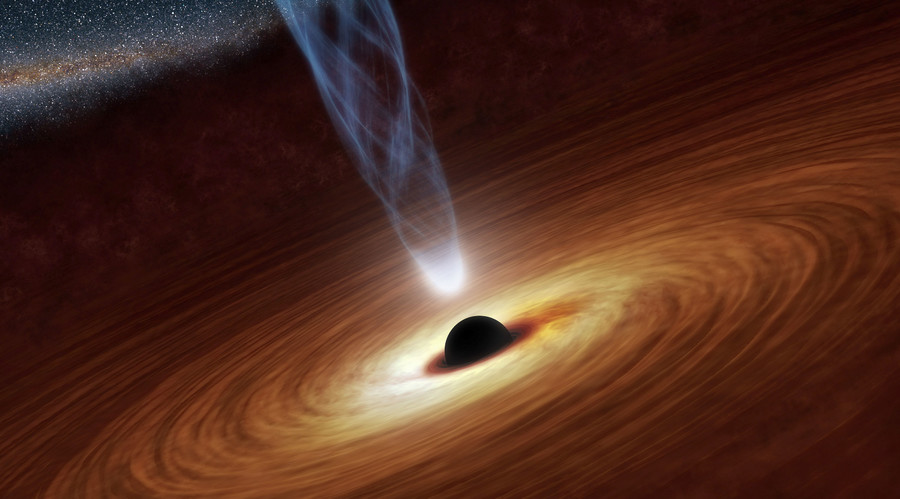
Physicists around the world confirmed they had detected unambiguous signals of gravitational waves emanating from the collision of two massive black holes 1.3 billion light years away in deep space.
As the two black holes spiralled together in a violent collision that was over in 20 thousandths of a second, immense amounts of matter – equivalent to the mass of three suns – were instantly converted into energy.
This sent shock waves travelling through space for 1.3 billion years until they were picked up by gravitational-wave instruments on Earth on 14 September last year.
The detection of gravitational waves not only confirms Einstein’s general theory of relativity, it amounts to the first direct detection of a pair of colliding black holes, the mysterious structures in space that are so dense they exert a gravitational force from which nothing – not even light – can escape.
“We’re opening a window on the universe, the window of gravitational wave astronomy. It’s the first time the Universe has spoken to us in gravitational waves. This was a scientific moonshot and we did it. We landed on the Moon,” said David Reitze, executive director of the US’s Laser Interferometer Gravitational Wave Observatory (Ligo), who announced the discovery at a press conference in Washington.
Two sets of super-sensitive instruments at two locations in the US both detected the same sub-atomic movements in the space-time continuum – the mathematical model that weaves space and time into a single entity – caused by the gravitational waves as they stretched and compressed the Earth.
The first gravitational-wave signal was picked up at the Ligo’s Hanford observatory in Washington State and then, seven thousands of a second later, an identical signal was picked up at Ligo’s Livingston site in Louisiana some 2,000 miles away.
This twin detection of the same signal was critical for statistical confirmation of the discovery.
“You can only believe they are real if you observe them at the same time in two different places,” said Professor Gabriela Gonzalez of Louisiana State University, the spokesperson for Ligo.
“We can hear gravitational waves. We can hear the Universe…that’s the chirp we’ve been looking for. That’s the signal we have measured. It’s monumental – like Galileo using a telescope for the first time,” Professor Gonzalez said.
The direct detection of gravitational waves will now enable astronomers to see the Universe in a different light, giving them an unprecedented opportunity to observe the “dark” side of the cosmos, almost back to the beginning of time itself.
It will enable scientists to build a network of gravitational-wave observatories both on Earth and in space that will see through the darkest voids of the cosmos.
It will give astronomers the ability to witness collisions between black holes and the interactions of massive stellar objects, even providing them with a time machine to look back almost to the earliest moments after the Big Bang 13.7bn years ago when the super-heated Universe began to cool down to form the first atoms.
“This detection marks not only a confirmation of Einstein’s theories but most exciting is that it is marks the birth of gravitational astronomy,” said Professor Sheila Rowan, director of the University of Glasgow’s Institute for Gravitational Research.
“This expands hugely the way we can observe the cosmos, and the kinds of physics and astrophysics we can do.”
Einstein first predicted the existence of gravitational waves in 1916 as a result of his general theory of relativity, the most commonly accepted description of gravity, published a year earlier.
However, despite decades of searching, gravitational waves proved too elusive for the most sensitive of gravity-detecting instruments – until now.
Scientists from Ligo confirmed in Washington what had been rumour for several weeks.
They had witnessed changes in their laser measurements at Ligo’s two observatories that could only be due to gravitational waves stretching and contracting space-time as they passed by the Earth.
The observation of the gravitational waves produced by the collision of the two back holes is officially known as GW150914. Scientists said it marked a new era in the scientific exploration of the Universe and the laws of physics that control it.
“The observation of GW150914 marks three milestones for physics: the direct detection of gravitational waves, the first observation of a binary black hole, and the most convincing evidence to-date that nature’s black holes are the objects predicted by Einstein’s theory,” said Professor Alberto Vecchio of the University of Birmingham’s School of Physics and Astronomy.
Ed Daw, a physicist at University of Sheffield, said: “A measure of its significance is that even the source of the wave, two black holes in close orbit, each tens of times heavier than the Sun which then collide violently, has never been observed before, and could not have been observed by any other method. This is just the beginning.”
If the space-time continuum is like a taut trampoline, then massive objects are like heavy bowling bowls distorting the trampoline’s fabric. When massive objects interact – such as colliding black holes – they send ripples known as gravitational waves travelling at the speed of light through spacetime.
loading...





0 Comments
We Will Love to Hear From You! Pls Comment Your Views...........